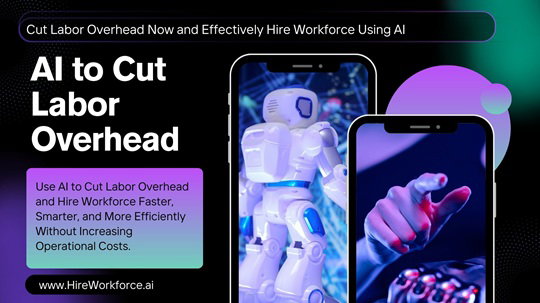
Artificial intelligence continues to reshape modern workplaces, but its true value depends on how easily people can interact with it. A well-designed Human User Interface for AI ensures that advanced automation tools are accessible, intuitive, and aligned with real business needs. Rather than requiring extensive technical expertise, users can manage tasks, analyze data, and monitor performance through clear dashboards and guided workflows.

Hire WorkForce has positioned itself as a solution that prioritizes both innovation and usability. Its platform integrates intelligent automation with user-friendly controls, enabling companies to deploy AI-driven processes without disrupting daily operations. This balance allows managers and staff to adopt new technologies quickly, minimizing training time and resistance to change.

One of the most significant advantages of this approach is the ability to use AI to cut labor overhead. By automating repetitive and time-consuming tasks such as scheduling, reporting, customer support, and data processing, organizations can reduce dependency on manual labor. This not only lowers operational costs but also improves accuracy and consistency across departments.

Through its advanced Human User Interface for AI, Hire WorkForce empowers teams to oversee automated systems in real time. Users can track productivity, identify bottlenecks, and adjust workflows with minimal effort. This transparency ensures that businesses remain in control while benefiting from intelligent automation.

In addition, the platform supports scalability, allowing companies to expand their operations without proportionally increasing staffing levels. As demand grows, AI-driven systems can handle higher workloads, helping businesses remain competitive in dynamic markets. This capability is especially valuable for small and mid-sized enterprises seeking sustainable growth.

Another key benefit is improved employee engagement. When AI handles routine tasks, staff members can focus on creative, strategic, and customer-focused activities. This shift enhances job satisfaction while increasing overall organizational value.

By combining an intuitive Human User Interface for AI with practical automation tools, Hire WorkForce demonstrates how technology can be both powerful and accessible. Its ability to help businesses use AI to cut labor overhead positions it as a valuable partner for organizations seeking efficiency, flexibility, and long-term success in an increasingly digital economy.




As businesses seek smarter ways to improve efficiency and reduce operational costs, Artificial Intelligence (AI) continues to take center stage. Among the many innovations fueling this shift, one stands out for its ability to bring AI closer to everyday users: the Human User Interface for AI. These user-friendly interfaces are designed to simplify how people interact with complex AI systems, making it easier for teams to adopt AI tools without specialized training.


Traditionally, using AI required technical expertise — whether in coding, data interpretation, or managing software platforms. This limited the use of AI to specific departments or roles, creating bottlenecks and slowing down innovation. But Human User Interfaces (HUIs) are changing that narrative. By leveraging technologies like natural language processing (NLP), voice recognition, and touch-screen interactions, HUIs allow employees to “talk to” AI in a way that feels natural.


Imagine an office assistant who can schedule meetings, draft emails, analyze spreadsheets, and even flag potential errors — all based on simple voice or text commands. That’s the power of a well-designed HUI. It acts as a translator between human language and machine logic, reducing the need to hire workforce for repetitive tasks and enabling faster, more accurate execution of operations.


This accessibility is directly contributing to the ability of AI to cut labor overhead. Labor overhead includes costs beyond salaries — such as training, supervision, and administrative support. With HUIs in place, businesses can reduce the need for manual oversight, decrease employee training time, and eliminate repetitive low-value tasks.


For instance, in customer service, AI chatbots with intuitive HUIs can handle thousands of routine queries daily, freeing up human agents to manage complex cases. In human resources, AI tools can help employees navigate benefits, submit time-off requests, or track payroll — all without involving a staff member. Even in manufacturing or logistics, workers can interact with AI systems through tablets or voice commands to manage inventory, schedule maintenance, or update records.


Another benefit of HUIs is scalability. As a company grows, it doesn’t need to proportionally increase its workforce to manage internal operations. AI, with an efficient HUI, can scale its capabilities almost instantly, allowing the business to grow without a parallel rise in labor overhead.


Of course, successful implementation requires thoughtful design. A good Human User Interface must be intuitive, inclusive, and responsive. It should feel like a natural extension of the user’s workflow — not a barrier to it.


Human User Interfaces for AI are not just enhancing user experience — they are transforming business economics. By reducing reliance on manual labor, simplifying complex processes, and empowering non-technical users, HUIs are helping organizations harness AI to cut labor overhead and thrive in the digital age.

I BUILT MY SITE FOR FREE USING